


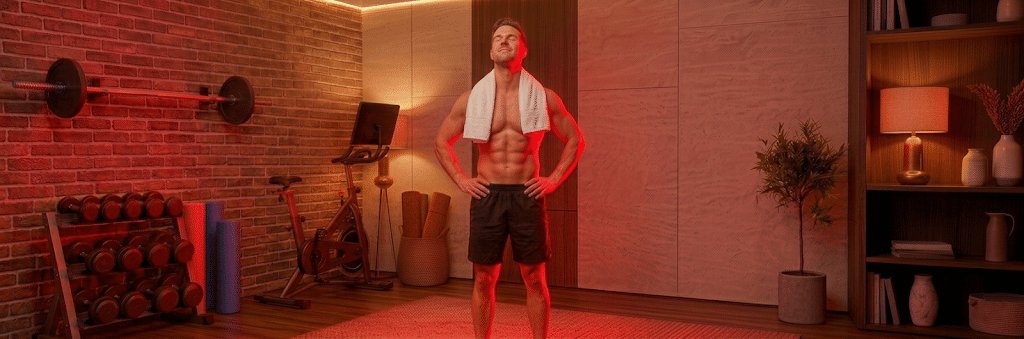

Meta description: Learn how to use red light therapy after workouts for faster muscle recovery. This guide covers timing, session length, distance, muscle group targeting, and which EmberPRO panel fits your routine.
Red light therapy can be a genuinely useful part of a post-workout recovery routine, but only when the setup is repeatable. A lot of people use it once or twice after a hard session and then decide it either works or it does not. That is the wrong way to judge it. Like most recovery tools, it works best with consistent timing, the right distance, and a routine matched to the muscles you actually train.
The good news is that this does not need to be complicated. You do not need a lab-style dosing plan. You just need a routine that fits real life.
Quick answer: how should you use red light therapy after a workout?
Use it the same day as training, for around 5 to 15 minutes per muscle group, at roughly 12 to 24 inches from the panel. If soreness is still building, repeat the session at 24 hours and again at 48 hours if needed. That approach makes far more sense than one random session immediately after the gym, because post-workout soreness often peaks over the next one to three days rather than right away.
Why Do People Use Red Light Therapy for Muscle Recovery?
The goal is simple: recover faster, feel less beaten up, and get back to training in better shape.
In research terms, this falls under photobiomodulation, where red and near-infrared light influence cellular processes linked to recovery. The mechanisms most often studied include mitochondrial activity, ATP production, nitric oxide signalling, and changes in inflammatory and oxidative stress pathways. In plain terms, red light therapy may help the body handle recovery more efficiently when the timing and dose are sensible.
The science is encouraging but not without nuance. Some studies show little effect when the protocol is poorly matched or expectations are too broad. More useful is the DOMS-focused research. A 2025 systematic review and meta-analysis found moderate reductions in pain later in the recovery window and stronger improvements in strength recovery at 24 to 48 hours in several protocols. That matters because it lines up with how soreness actually behaves. The day after a workout is often more relevant than the moment you leave the gym.
Red light therapy works best as part of a broader recovery approach that already includes good sleep, adequate protein, hydration, and sensible training load. Used that way, it becomes a practical tool rather than a vague wellness add-on.
When Should You Use Red Light Therapy After a Workout?
For most people, the best answer is the same day, then again the next day if soreness is building.
You do not need to chase a perfect post-gym window. Using red light therapy right after training is fine, but later the same day, such as after a shower or in the evening, works equally well. What matters more is that you do it consistently and repeat it across the recovery period.
That timing matters because delayed onset muscle soreness often builds over 24 to 72 hours, especially after harder sessions, unfamiliar movements, or high-volume leg work. A realistic post-workout routine looks more like this:
– Use it the same day as training
– Use it again at 24 hours if soreness is coming in
– Use it again at 48 hours if soreness is still present
– Repeat at 72 hours after especially demanding sessions
This matches what the research suggests. Some of the most useful DOMS findings show that recovery effects are often more relevant over the next one to four days than in a single immediate session. Same-day plus follow-up is the smarter approach.
How Long Should Each Post-Workout Session Be?
A good starting point is 5 to 10 minutes for smaller muscle groups and 8 to 15 minutes for larger ones.
Shoulders, chest, arms, elbows, and calves sit toward the shorter end. Quads, hamstrings, glutes, and lower back sit toward the longer end. Full-body or multi-area sessions take longer overall, but that becomes a panel-size issue more than anything else. A larger panel covers more at once, keeping the routine practical. A smaller one means more repositioning and more total time.
Session length varies because the real factor is delivered dose, not just time. Dose depends on irradiance at your actual working distance, combined with how long you stay there. A stronger panel at a sensible distance may need less time than a weaker setup farther away. More is not automatically better. Photobiomodulation is dose-dependent, and exceeding the useful range does not improve results.
The practical approach: pick a session length that suits the muscle group, keep it consistent for a couple of weeks, and judge how your body responds across the following 24 to 48 hours.
How Far Should You Stand from the Panel?
For most post-workout routines, 12 to 24 inches is the right starting range.
Closer distances work well for smaller, targeted areas like shoulders, elbows, knees, or one side of the chest. Farther distances often work better for larger areas like quads, glutes, hamstrings, or lower back because they improve coverage and feel more comfortable over a broader region.
The main thing is to keep the distance consistent. If one session you stand 6 inches away and the next you stand 24 inches away for the same duration, you are not running a repeatable protocol. Pick a distance that feels practical, keep it stable, and only adjust if there is a clear reason to do so.
There is also a practical comfort point here. Standing too close on already sore tissue can feel harsher than it needs to. Standing too far reduces efficiency. A consistent middle ground is close enough to be effective and far enough to be comfortable.
How to Use Red Light Therapy for Different Muscle Groups
The most useful thing you can do is stop thinking of post-workout red light therapy as one generic routine and start matching it to the muscles you actually trained.
General rule: the bigger the muscle group, the more coverage matters. Compact panels work well for localised soreness. Larger muscle groups benefit from mid-size or large panels that cut down repositioning and keep sessions realistic.
Shoulders, chest, and arms after push day
After bench press, overhead press, dips, or high-volume push-ups, shoulders, chest, and triceps are the main areas to target. These are relatively easy to work into a routine because they do not demand the same coverage as leg or posterior chain work.
A practical starting setup:
– Distance: around 8 to 16 inches
– Session time: around 6 to 10 minutes per area
– Timing: same day, then again at 24 hours if soreness is building
A compact panel handles this well. A mid-size panel is more efficient if you want to treat both shoulders and chest in one block without moving the device around.
Quads, hamstrings, and glutes after leg day
Leg day is where recovery routines either start making sense or start becoming frustrating, and panel size is usually why.
Quads, hamstrings, and glutes are large muscle groups. You can use a compact panel, but this is where many people quickly realise it is not big enough for the way they train. Repositioning becomes tedious and consistency drops fast.
A practical starting setup:
– Distance: around 12 to 24 inches
– Session time: around 8 to 15 minutes per area
– Timing: same day, plus 24 hours, plus 48 hours if soreness is still rising
Since DOMS after leg training often builds across the next one to three days, a same-day session alone is rarely enough for a proper recovery routine. This is one of the clearest cases for a mid-size or large panel.
Lower back after deadlifts
Lower back recovery after deadlifts, heavy rows, or posterior chain work should prioritise broad, comfortable coverage rather than pinpoint treatment.
A practical starting setup:
– Distance: around 12 to 24 inches
– Session time: around 8 to 12 minutes
– Timing: same day, then again at 24 hours if stiffness is still present
The most common mistake here is standing too close and making the session feel harsher than it needs to be. If glutes and upper hamstrings are also tight, a mid-size or larger panel handles the full area in one position rather than requiring multiple moves.
Does Panel Size Affect Post-Workout Recovery?
Yes, because it directly affects how practical the routine feels over time.
A compact panel works well when the recovery goal is localised: one shoulder, a knee, elbow tightness, or one side of the chest. Once the routine starts including quads, glutes, hamstrings, lower back, or multiple areas in one session, a small panel starts to feel restrictive. Not because it stops working, but because it makes the routine harder to keep.
A mid-size panel is the sweet spot for most gym users. It gives enough coverage for upper body, lower back, and moderate leg work without being too large or awkward. A large panel is the best fit when you regularly train big muscle groups, want multi-area recovery in one session, or want to reduce repositioning as much as possible.
Panel size does not change the biology. It improves session efficiency, and session efficiency is what drives consistency.
Which EmberPRO Panel Is Right for Your Recovery Routine?
We designed the EmberPRO lineup around exactly the kind of thinking in this guide: real training schedules, real body areas, and real routines that need to be repeatable. The difference between the three models is not just output. It is how much area they cover comfortably and how much time they save in a real session.
EmberPRO 100 for localised soreness
The EmberPRO 100 is the right fit if your post-workout use is mostly targeted: shoulders, arms, elbows, knees, calves, or other smaller problem areas. It works well after push day or for a single sore region, but it is the model most likely to feel too small if your routine regularly includes quads, glutes, hamstrings, or lower back.
EmberPRO 200 for most gym users
For most regular lifters, the EmberPRO 200 is the most balanced choice. It gives noticeably better coverage than the 100, handles upper-body sessions more comfortably, suits lower-back work after deadlifts, and makes moderate leg recovery much more practical. If you train several times a week and want a repeatable routine across different muscle groups, this is usually the right pick. It is the model we most often recommend for general gym use.
EmberPRO 650 for broader recovery routines
The EmberPRO 650 is the best fit when your routine regularly includes large muscle groups or multiple treatment areas in one session. The main advantage is not just size. It is that it cuts repositioning enough to make broader recovery routines feel genuinely practical, whether that means front-and-back sessions, full leg-day recovery, or a wider post-workout block.
All three models publish irradiance data at real working distances, carry a 3-year warranty, and include app-based control so session tracking is easy. We built the EmberPRO range around the same criteria this article uses to judge a good recovery routine, because those are the things that actually determine whether a panel gets used or ends up sitting in a corner.
Final Guidance: Build a Recovery Routine You Can Actually Keep
The best post-workout red light therapy routine is not the most intensive one. It is the one you will still be doing a month from now.
Use it the same day as training. Repeat at 24 hours if soreness is building, and again at 48 hours if needed. Keep sessions between 5 and 15 minutes depending on the muscle group. Stay at a consistent distance, somewhere in the 12 to 24 inch range. Match the panel size to the body areas you actually train.
The most common mistake is not using red light therapy incorrectly in some technical sense. It is making the routine too awkward to keep. If the panel is too small, the distance inconsistent, or the setup too slow, it becomes another abandoned recovery tool.
Simple recommendation:
– Choose the EmberPRO 100 for localised soreness and targeted post-workout use
– Choose the EmberPRO 200 for most regular gym routines
– Choose the EmberPRO 650 for broader, multi-area recovery and less repositioning
For most people, the EmberPRO 200 is the safest pick. It gives enough coverage to make real post-workout routines practical without being excessive for normal home use.
Frequently Asked Questions
How soon after a workout should I use red light therapy?
The same day is the best starting point. Right after training works, but later that day is just as effective. If soreness builds the next day, repeat the session at 24 hours and again at 48 hours if needed.
How long should each post-workout red light therapy session be?
A good starting range is 5 to 10 minutes for smaller muscle groups and 8 to 15 minutes for larger ones like quads, glutes, hamstrings, or lower back.
What distance should I stand from the panel?
For most routines, 12 to 24 inches is a practical starting range. Closer distances work for small targeted areas. Farther distances often suit larger muscle groups better.
Should I use red light therapy on rest days?
Yes. That often makes good sense, especially because soreness typically peaks after the workout day rather than during it.
Is red light therapy better right after training or the next day?
Both can help. Same-day use is a solid starting point, but next-day use is often just as important because soreness and stiffness are usually more noticeable then.
Can I use red light therapy every day?
You can, but more is not always better. The smarter approach is to use it consistently around your training and recovery needs rather than assuming longer or more frequent sessions automatically produce better results.
Is red light therapy enough on its own for recovery?
No. It works best as part of a wider recovery routine that includes good sleep, hydration, adequate protein, and sensible training load. It is a useful tool, not a replacement for the basics.