


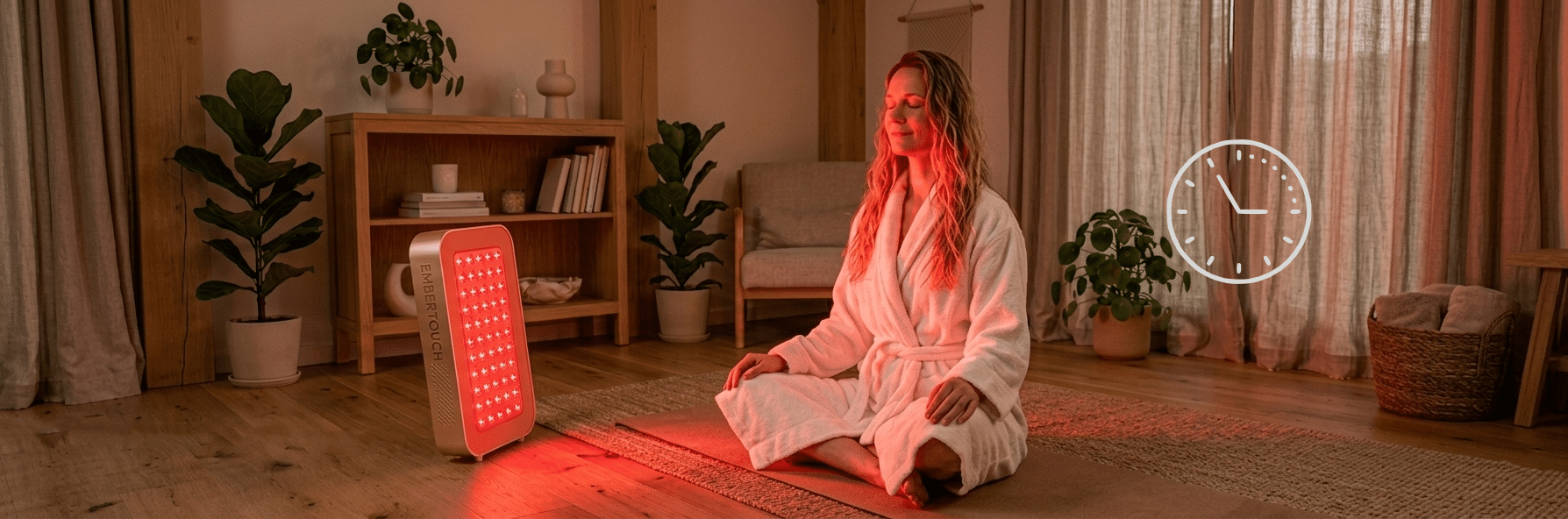

Meta description: Wondering how often to use red light therapy at home? This guide covers the ideal frequency for skin, recovery, pain relief, and maintenance, based on your goal and device.
Quick answer: For most people, the best starting point is 3 to 5 sessions per week. That is the most consistent range across clinical guidance, major at-home device brands, and peer-reviewed research. Skin routines, recovery routines, and pain-relief protocols all tend to fall in that range with maintenance dropping lower once results are established.
Here is the simple breakdown by goal:
Skin and face: 3 to 5 times per week; daily if sessions are short and easy to maintain
Muscle recovery and post-workout: 3 to 5 times per week, ideally on training days
Pain, tension, or joint support: often 4 to 7 times per week to start, then tapering back
Maintenance: 1 to 3 times per week once a solid baseline is established
But frequency alone does not determine your results. The right routine also depends on how long each session is, how strong your device is at your chosen distance, which area you are treating, and, most importantly, whether the habit is realistic enough to sustain. That is what most generic guides miss.
What Does Red Light Therapy Frequency Actually Depend On?
The right red light therapy frequency comes down to four practical factors: your goal, your device’s output, your treatment area, and your ability to stay consistent.
1. Your goal
A face routine typically involves shorter sessions on a small area, so higher frequency is easy to maintain. A post-workout recovery routine covering larger muscle groups often requires more structure. Someone managing knee pain has a very different starting point to someone running an anti-ageing skin protocol. Frequency should always be matched to what you are actually trying to achieve.
2. Your device’s output (irradiance)
Irradiance (the power your device delivers per square centimetre) directly affects how long each session needs to be. A higher-output panel at an effective working distance can often deliver a similar therapeutic dose in less time than a weaker device. That is why blanket advice like “use it every day for 20 minutes” is too vague on its own. Without knowing your device’s strength and distance, the number is almost meaningless.
3. Your treatment area
A compact face routine is far easier to repeat than a broader body routine that involves setup, repositioning, and extra time. Habit friction is real, if a routine becomes awkward or slow, people skip it. That means treatment area and convenience should always be factored into your frequency plan, not treated as separate decisions.
4. Consistency over intensity
This is the most important factor. Photobiomodulation does not work like a one-off treatment. The pattern across medical guidance, clinical studies, and brand protocols is consistent: results come from repeated use over weeks and months, not from cramming in extra sessions in week one.
Research also describes a biphasic dose response; the principle that more is not always better. Too little exposure may produce minimal effect; too much does not necessarily improve outcomes. A shorter, well-structured routine you actually stick to will outperform an “ideal” schedule that collapses after five days.
How Often Should You Use Red Light Therapy for Different Goals?
How often for skin and face routines?
For skin and face use, 3 to 5 sessions per week is the most widely supported starting point. Daily use is also effective when sessions are short (around 5 to 10 minutes) and easy to slot into an existing skincare habit, but it is not the only path to results.
A 2023 skin-ageing study using a consumer LED mask found visible improvements with 12-minute sessions, just twice a week, over three months. That is a useful reminder that consistency matters more than chasing an aggressive schedule. Harvard Health and the American Academy of Dermatology both emphasise the same message: results build over weeks and months, not in one intense week.
Beginner tip: If daily use feels sustainable, it can work well. If it feels like too much, 3 to 5 times per week is more than sufficient.
How often for muscle recovery and post-workout use?
For muscle recovery, 3 to 5 times per week anchored to training days is the strongest practical approach. If you train four times a week, pairing red light therapy with those sessions already gives you a sensible and sustainable structure, without needing to build a completely separate wellness ritual.
Reviews of photobiomodulation for sports performance show that protocols vary, but repeated use around exercise timing is the consistent thread. Panel size matters here too: a broader panel reduces repositioning and makes a 3 to 5 times weekly routine much easier to maintain across larger muscle groups.
How often for pain, tension, or joint support?
For targeted pain, tension, or joint support, many people start more frequently (4 to 7 times per week) then taper back once the routine feels established. This works well for short, easy-to-repeat sessions: a morning session on a stiff knee, a regular routine for shoulder tension from desk work, or a repeatable setup for wrist or lower-back discomfort.
The goal is not maximum exposure. It is building a routine consistent enough that you do not abandon it. Starting at high frequency with long sessions is also where overuse is most common, so keep sessions short and adjust based on comfort.
How often for maintenance?
Once you have built a consistent routine and reached a good baseline, 1 to 3 sessions per week is usually enough to maintain results. This pattern is especially common in skin-focused protocols, where brands often recommend an initial course followed by a lighter long-term schedule.
Maintenance frequency is a useful concept to internalise early, it means the most demanding phase does not last forever. Starting with regular sessions and easing into something lighter once the habit is established is a much more realistic long-term approach than “use it constantly.”
Daily vs 3 to 5 Times a Week: Which Works Better?
For most people, 3 to 5 times per week works better than jumping straight to daily use.
Daily use absolutely works, but only when the habit is low-friction and easy to repeat. A seven-day plan that becomes annoying by day five will produce worse results than a four-day plan maintained consistently for three months. Manufacturer guidance and clinical literature both reflect this: regularity matters more than aggression.
A simple way to decide:
Choose daily if sessions are short, comfortable, and already attached to something you do every day, like a skincare routine
Choose 3 to 5 times per week if the treatment area is larger, the setup takes longer, or you are building a recovery routine around training days
Choose 1 to 3 times per week once you are in a maintenance phase and no longer need the more intensive rhythm
If you are unsure where to start, 3 sessions per week is the most forgiving entry point; enough to build momentum, not so much that it becomes overwhelming.
—
How Long Should Each Red Light Therapy Session Be?
For most home users, 5 to 10 minutes per session is a strong practical range.
This aligns with the majority of brand guidance and makes sense when you factor in device strength and treatment area. LED masks often use a fixed 10-minute session. Higher-output panels can sometimes deliver a comparable therapeutic dose in less time, especially at shorter working distances.
The session length that matters for you depends on three things: intensity, distance from the device, and the size of the area you are treating.
| Use Case | Suggested Session Length |
| Face / skin routines | 5 to 10 minutes |
| Joints, pain, or targeted areas | 5 to 10 minutes per area |
| Broader body or recovery routines | 5 to 10 minutes (easier with a larger panel) |
A stronger device may reach a useful dose faster. A weaker or more distant device may need longer. Always read session length alongside frequency as they are not independent variables.
Does Panel Size and Intensity Affect How Often You Should Use It?
Yes, because they directly affect how realistic your routine feels.
A compact panel works well for a face routine, one knee, one shoulder, or a targeted area. But once you are treating broader muscle groups, maintaining frequency becomes harder if every session involves significant repositioning. A larger panel does not necessarily change the number of sessions per week, but it makes each one easier which is often what determines whether the habit lasts.
Intensity matters for a different reason. A stronger device at an effective working distance may allow shorter sessions, making higher-frequency use much easier to sustain. A weaker setup may still work, but it often demands longer sessions and more patience to get a similar result.
Many advice articles say “use it 3 to 5 times a week” without explaining that three short, efficient sessions with the right setup are very different from three slow, awkward sessions with the wrong one.
Morning or Evening: When Is the Best Time to Use Red Light Therapy?
The best time is the time you will actually repeat.
There is no universal rule that morning beats evening or vice versa. The better question is: where does a red light session fit most naturally into your existing routine?
Morning works well for a quick face session, a before-work joint routine, or building a consistency habit before the day gets busy
Evening works well for skincare, post-workout recovery, or a wind-down routine after training
After training is often the most logical slot for muscle recovery users, because it attaches the habit to something already in their schedule
The time on the clock matters less than whether the session fits naturally into an existing rhythm, because that is what determines whether it sticks.
What Happens If You Skip Sessions?
Missing one session rarely causes any meaningful setback.
The real problem is when a single skipped session becomes two weeks of inconsistency. Red light therapy is habit-driven. Most skin and recovery outcomes are discussed over timescales of weeks to months, so the routine only really breaks down when missed sessions become the pattern rather than the exception.
If you do skip:
Do not try to “make up” for it by doubling the next session
Simply return to the routine you were building
If skipping keeps happening, reduce session length or simplify the setup as the problem is usually friction, not motivation
Simple Red Light Therapy Routines You Can Actually Stick To
A short daily face routine
Best for: skin support tied to an existing skincare habit
Frequency: 5 to 7 days per week, or 3 to 5 if daily feels like too much
Session length: 5 to 10 minutes
Best time: morning or evening skincare
Why it works: short sessions are easy to keep, and face routines already fit into an existing habit
A 3 to 5 times weekly recovery routine
Best for: post-workout recovery or soreness support
Frequency: 3 to 5 times per week
Session length: 5 to 10 minutes per area
Best time: after training sessions
Why it works: it follows your workout schedule rather than requiring a completely separate ritual
A quick before-work session
Best for: people whose biggest challenge is inconsistency
Frequency: 3 to 5 days per week
Session length: 3 to 6 minutes to start
Best time: before getting dressed, or right after waking up
Why it works: keeping the habit small makes it easier to start, and starting is usually the hardest part
An evening wind-down routine
Best for: recovery, skincare, or a calmer end-of-day session
Frequency: 3 to 5 times per week
Session length: 5 to 10 minutes
Best time: after work or training, before bed
Why it works: it fits naturally into recovery and skincare rhythms and is often easier to protect than a rushed morning slot
Final Guidance: Build a Routine You Can Actually Keep
The most effective red light therapy routine is not the most intensive one. It is the one you will still be doing a month from now.
For most people, that means starting with 3 sessions per week, keeping sessions short, and only increasing frequency once the setup already feels easy. If your goal is skincare and the routine is simple, daily use makes sense. If your goal is recovery, 3 to 5 sessions per week tied to training days is usually the better fit. Once the habit is working, maintenance often drops to 1 to 3 sessions weekly.
Build around your goal, your available time, your treatment area, and your ability to stay consistent. Results come from consistency over time, not from trying to win week one.
Frequently Asked Questions
How often should you use red light therapy for skin?
Most people see good results with 3 to 5 sessions per week. Daily use is also effective if sessions are short and easy to fit into an existing skincare routine. Consistency over weeks and months matters more than the exact number of sessions per week.
Can you use red light therapy every day?
Yes, daily red light therapy is generally considered safe for at-home devices. However, daily use only helps if it is easy to maintain. For most people, 3 to 5 times per week produces comparable results with less pressure to keep a perfect streak.
How long does it take to see results from red light therapy?
Most people begin noticing changes after 3 to 4 weeks of consistent use. Skin tone, texture, and recovery improvements typically become more visible after 8 to 12 weeks of regular sessions.
Is it possible to overdo red light therapy?
Yes, in theory. Red light therapy follows a biphasic dose response, which means that beyond a certain point, more exposure does not continue to improve results and may reduce effectiveness. This is why session length and frequency guidelines exist as they help you stay within the effective therapeutic range.
What happens if I miss a red light therapy session?
Missing one session has no meaningful impact. The issue arises when missed sessions become a regular pattern. If that is happening, the fix is usually to simplify the routine; shorten the session, reduce the setup, or choose a more convenient time slot, rather than quitting altogether.
How many minutes per red light therapy session is ideal?
For most at-home devices, 5 to 10 minutes per session is a practical and effective range. Higher-output devices may deliver a similar dose in less time. Longer is not always better because the optimal dose depends on your device’s irradiance, the distance you use it from, and the area you are treating.